Chennai,
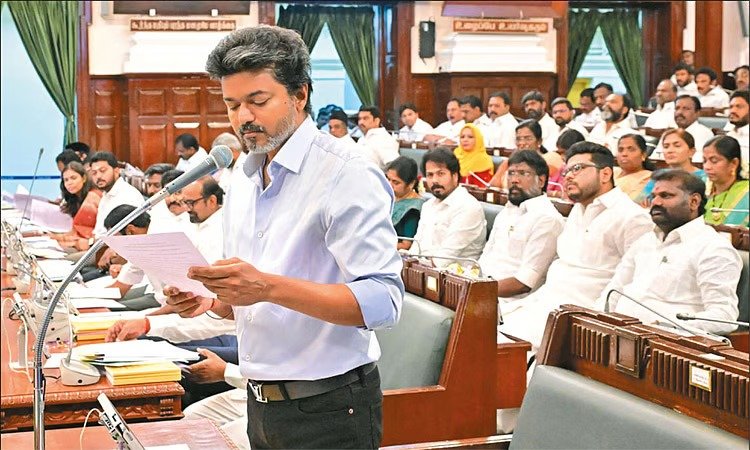
Amidst a financial crisis, the question arises: is a new Secretariat truly necessary? Let us examine this in detail. In the 105-year history of the Legislative Assembly—dating back to the era of the Madras Presidency before India's independence—the first session was held at Fort St. George on January 9, 1921. Although the venue shifted temporarily to locations such as Senate House (1937–1938), Rajaji Hall (1938–1939), Kalaivanar Arangam (1952–1956), Arranmore Palace in Ooty (1959—for 10 days), and the Omandurar Government Estate (2010–2011; currently the Government Multi-Super Speciality Hospital), the Assembly has primarily functioned within the Fort St. George complex for 98 years. New Secretariat at a cost of ₹1,200 crore: Against this backdrop, Chief Minister Joseph Vijay announced plans yesterday to construct a new Secretariat. He stated, "A new building complex comprising a Legislative Assembly and a Secretariat, equipped with modern amenities, will be constructed in Chennai, spanning 20 lakh square feet at an estimated cost of ₹1,200 crore." Several sites are under consideration for this project, including Foreshore Estate in Pattinapakkam, the Highways Research Station complex in Guindy, the Guindy Race Course, and government-owned land in Nandambakkam. Is it necessary amidst the financial crisis? At a time when the state's debt exceeds ₹10 lakh crore, the question of whether a new Secretariat is truly essential may arise in everyone's minds. Meanwhile, the delimitation of constituencies in Tamil Nadu is being carried out in accordance with the population. Currently, based on the 2011 census, there are 234 Assembly constituencies, but the number of constituencies is set to increase. After a gap of 15 years, a census is finally about to be conducted in Tamil Nadu. With the population estimated to have crossed 8 crores, it appears that the number of Assembly constituencies in Tamil Nadu will rise by 120—meaning the total will increase from 234 to 354. In the current Assembly hall at Fort St. George, the 234 MLAs are seated in cramped conditions. Furthermore, the areas designated for government officials (to the right of the Speaker's chair) and the press (to the left) lack adequate space. When the number of MLAs rises to 354 in the future, the current hall will certainly prove insufficient; a need for a new Secretariat building will inevitably arise.
Therefore, considering future requirements, constructing a new Secretariat building now is indeed necessary. The Tamil Nadu government comprises 55 departments, with their offices currently scattered across locations such as the Namakkal Kavignar Maligai (within the Secretariat complex), the Ezhilagam building (opposite the Labourer's Statue on Marina Beach), and the Panagal Maligai in Saidapet. Consolidating these offices in a single location would facilitate better administration. However, the DMK government, which was in power from 2006 to 2011, constructed a new Secretariat building at the Omandurar Government Estate and even conducted Assembly sessions there for about a year (2010–2011). Yet, the AIADMK government, which assumed power following the 2011 elections... The government had previously converted the new Secretariat building into a multi-specialty government hospital and relocated the Legislative Assembly back to its former premises. Consequently, a demand has arisen that the TVK government—upon assuming power—should enact legal safeguards to ensure that the new Secretariat building it plans to construct remains at its designated site, preventing any future relocation driven by political motives.
On the other hand, there is also a proposal to further upgrade the government multi-specialty hospital in Guindy, transfer the doctors, staff, and patients from the Omandurar Hospital to that facility, and convert the Omandurar building back into the Secretariat.

SOUTH ZONE NEWS
உண்மை · நேர்மை · நம்பிக்கை — தென்னகத்தின் குரல்... மக்களின் குரல்...

ஆதரிக்க
Scan to pay with any UPI app
UPI ID: southzonenewsdigital@oksbi